Showing posts with label theology. Show all posts

Saturday, February 24, 2007

Supremacy of Revelation

One of the more interesting ideas in By the Hand of Mormon by Terryl L. Givens is the idea that the Book of Mormon introduces a form of revelation that is rejected by most Western religions. He states that almost all Christians have described the word “Revelation” as a metaphorical transmission of God’s revealing Himself. There is no actual concrete information that is given to a person who contacts the Divine entity. The argument seems to be that to claim a direct communication of actual words is to 1) ascribe anthropomorphism to God who is not human and 2) be open to fanaticism and heresy. However, the Book of Mormon explicitly introduces “dialogic revelation” as a true sign of faith and spiritual development. It should be part of the lives of everyone:

The Book of Mormon here becomes a study in contrast. Through chiastic form, thematic structure, numerous textual examples, and a final concluding instance of readerly invitation, the scripture hammers home the insistent message that revelation is the province of everyman. As a consequence, in the world of the Book of Mormon, concepts like revelation, prayer, inspiration, mystery find powerful and substantive redefinition. That may well be the Book of Mormon’s most significant and revolutionary – as well as controversial – contribution to religious thinking. The particularity and specificity, the vividness, the concreteness, and the accessibility of revelatory experience – those realities both underlie and overshadow the narrated history and doctrine that constitute the record. The “knowability” of all truth, the openness of mystery, the reality of personal revelation find vivid illustration within the record and invite reenactment outside it. (Givens, pg. 221)


This presents for Mormons a very strong challenge. It is not enough to simply feel good about spiritual experiences and consider us enlightened. Receiving revelation must take a step beyond the metaphorical and become literal. As Joseph Smith explained, “A person may profit by noticing the first intimation of the spirit of revelation; for instance, when you feel pure intelligence flowing into you, it may give you sudden strokes of ideas, so that by noticing it, you may find it fulfilled the same day or soon.” (TJS, pg 151). Ultimately, the purpose of “dialogic revelation” is to bring Salvation by bringing us into the very presence of God with the knowledge gained. Again, as Joseph Smith has said, no one can be saved in ignorance. This is more than a prescription to book learning, but direct instruction to search out Heavenly communication for our own eternal welfare. Indeed, it is the key to that most forgotten subject of much speculation; the Second Comforter.

It is often stated by Latter-day Saints that the return of Revelation and Prophets is the central originality of Mormonism. What is perhaps less acknowledged is that personal revelation is as important a theological teaching as any corporate claim of authoritative pronouncements. Of course, it has been taught almost from the beginning that no revelation is accepted outside of a person’s authoritative jurisdiction. That still leaves room for the equally necessary individual communication with the Divine. Despite what Givens says about the Bible having almost no discussion of personal revelation, Mormons often quote Numbers 11: 24-29 as instructive:

24 And Moses went out, and told the people the words of the LORD, and gathered the seventy men of the elders of the people, and set them round about the tabernacle.

25 And the LORD came down in a cloud, and spake unto him, and took of the spirit that was upon him, and gave it unto the seventy elders: and it came to pass, that, when the spirit rested upon them, they prophesied, and did not cease.

26 But there remained two of the men in the camp, the name of the one was Eldad, and the name of the other Medad: and the spirit rested upon them; and they were of them that were written, but went not out unto the tabernacle: and they prophesied in the camp.

27 And there ran a young man, and told Moses, and said, Eldad and Medad do prophesy in the camp.

28 And Joshua the son of Nun ,the servant of Moses, one of his young men, answered and said, My lord Moses, forbid them.

29 And Moses said unto him, Enviest thou for my sake? would God that all the LORD’s people were prophets, and that the LORD would put his spirit upon them!


With so much emphasis on Revelation, there is still less practical applications observable in the lives of Latter-day Saints. This is not to say that many don’t hold the concept in high esteem as theory. Yet, when asked what was the last revelation a person remembers having, many if not most Mormons would probably point to the time they gained a testimony or a missionary story. Two possibilities are that revelation is not recognized when received or it is not easy to obtain. Considering the importance placed on communicating with God, it might be time to practice recognizing the intimations of the Spirit in a more "enthusiastic" tradition. Not a simple task, but essential to Salvation.

Humor and the Gospel

No longer available due to publishing issues.

Saturday, February 17, 2007

Theory of Mormon Theology

There was a discussion about the value of theology that questioned why Latter-day Saints have such a hard time accepting the study of theology. It got me thinking of my own interest in the subject. Surely Mormons dabble in the study of theology more than credit has been given. They just don't know it. Discussing the personal opinions about the Last Days and what the Afterlife will be like can generate a lot of theological debate. The confusing might be on how casual it all can sound. There is a disjointedness that is hard to say creates a formal approach to doctrinal exigesis.


Mormons probably don’t like (systematic) theology because of the attitudes of the early leaders, particularly Joseph Smith. Theology is often interpreted as dogma, and “dogma” is considered even worse than theology because of the inherent rejection of new revelation. The word “doctrine” is far more accepted a term because it isn’t seen as related to a closed set of rules and beliefs. Thus, why Bruce R. McConkie's book was named “Mormon Doctrine” rather than “Mormon Theology” when published.


Saturday, February 10, 2007

Divine Motherhood

One of the unique doctrines of the LDS Church is the existence of a Mother in Heaven. It is more than a trivial speculative idea, but part of the foundational teachings associated with Exaltation. Although particulars are not available, the doctrine is enshrined in one of the most beloved hymns “Oh My Father” by Eliza R. Snow. It states, “in the heavens, are parents single?” and replies, “no . . . truth eternal tells me I’ve a mother there.” President Wilford Woodruff proclaimed the hymn a revelation. To add to that, it is impossible to fully comprehend the doctrines of eternal families without accepting the implications.

Yet, some are troubled by the lack of particulars. Usually those who would like women to have a greater role in the LDS Church, and especially would like Priesthood positions granted to them voice these concerns. The refrain to such requests is “the subject is too sacred,” or more forcefully, “God doesn’t want His wife mocked and ridiculed by the World as He lovers Her too much.” There is truth in this, but it doesn’t really answer the question of near silence. The Scriptures don’t even hint this. Prophets, if they have said anything at all, have not made that proclamation (although they have numerous times in relation to Temple ordinances) a central concern. There are some answers, but not ones that will either close off the discussion or be comforting to the critics of minimalism.

On Earth as In Heaven

What we know about our Heavenly Mother is perhaps more than realized. This is because most Mormons, both “progressive” and “traditional” are looking for things overly transcendent. The “Easy to understand” is seen as less worthy of respect then something that can be forever argued and dissected. Perhaps worse for some is that the conclusion of Her nature casts a shadow on certain aspirations.

The key to understanding Heavenly Mother is both in the name and a simple verse of the Doctrine and Covenants. It occurs in the famous “Civil War Prophecy” of D&C 130:

1 When the Savior shall appear we shall see him as he is. We shall see that he is a man like ourselves.

2 And that same sociality which exists among us here will exist among us there, only it will be coupled with eternal glory, which glory we do not now enjoy.


Although it has more to do with the nature of God and our relation to Him than gender issues, the idea expressed of “that same sociality” has repercussions. There is not a lot of differences between what we observe here on Earth and human nature in the Eternities. It is true that we are perhaps more prone to sin, misunderstanding, lies, and mistakes in mortality. Yet, it is clear that mothers are a very important part of the social fabric of humanity. To understand motherhood is to understand Heavenly Mother, just as Fatherhood brings its own lessons. The recent Proclamation on the Family emphasizes the Earthly relationships of gender to Eternal truth:

We, the First Presidency and the Council of the Twelve Apostles of The Church of Jesus Christ of Latter-day Saints, solemnly proclaim that marriage between a man and a woman is ordained of God and that the family is central to the Creator's plan for the eternal destiny of His children . . .

. . . By divine design, fathers are to preside over their families in love and righteousness and are responsible to provide the necessities of life and protection for their families. Mothers are primarily responsible for the nurture of their children. In these sacred responsibilities, fathers and mothers are obligated to help one another as equal partners. Disability, death, or other circumstances may necessitate individual adaptation. Extended families should lend support when needed.


Therefore, we know that Heavenly Mother is just that; a woman who takes care of children. There is no pretence as to how that can be achieved other than through the known doctrine of Faith, Hope, and Charity or more succinctly Love. Learn how to cultivate those characteristics and the more the nature of Heavenly Mother will become clear. For those who believe that raising children is a disgrace or beneath a fully spiritual identity, Jesus had some choice words:

10 Take heed that ye despise not one of these little ones; for I say unto you, That in heaven their angels do always behold the face of my Father which is in heaven.

11 For the Son of man is come to Save that which was lost.

-- Matt. 18: 10-11


Of course, not every woman has the opportunity to marry or raise children here on Earth. However, if Heaven is the ideal and families reflect Heaven, then Time only is of concern and not ultimate circumstances. There is much that we must, as religious people, hope for in the next life that cannot be attained in mortal probation. Marriage and children might be part of that anticipation for a better Eternal life. Creating a false Goddess figure only separates us from real Salvation through Jesus Christ.

Worship and Salvation

This possibility is not without precedent. Some scholars have seen within the Bible a fight for repressing a more female oriented worship. In other words, additional theology of a fertility Goddess that either goes with or usurps the male God that is accepted as the I AM that should have no other Gods before Him. Some would say the “go with” is not theologically unacceptable. However, Jesus warned:

17 But he, knowing their thoughts, said unto them, Every kingdom divided against itself is brought to desolation; and a house divided against a house falleth.

18 so be divided against himself, how shall his kingdom stand? because ye say that I cast out devils through Beelzebub.

--Luke 11: 17-18


It would be near impossible not to develop two theological worship systems that didn't diverge. Like manna, a choice between one and the other would be inevitable when both insist upon our devotion. As is clearly taught in the Scriptures, Jesus Christ has already been established as the only Way to Salvation; and he does not give room for another deity beyond Father as the focus of our Prayers. It is true that he acts with God, but ultimately he gives the glory to God. There is an example of prayer to enhance this point:

9 After this manner therefore pray ye: Our Father who art in heaven, hallowed be thy name.

10 Thy will be done on earth as it is in heaven.

11 And forgive us our debts, as we forgive our debtors.

12 And lead us not into temptation, but deliver us from evil.

13 For thine is the kingdom, and the power, and the glory, forever. Amen.

-- 3 Ne. 13: 9-13


The nature of Heavenly Mother is clearly defined, as is her role. Scriptures do not mention Her because she is not part of the plan of salvation beyond what we already know of motherhood. The deity we worship continues to be Father, Son, and Holy Ghost as One, and They have been consistent on who and what we must do to be saved. If honesty is important, those who want to “graduate” the female half of Heavenly Parents must acknowledge there isn’t much known about Father in Heaven either. We know as much as we do about Him because Jesus is His representative. Ultimately it is through Jesus Christ that we get near the Father, and it is through the Father that the Mother can be percieved.

Sunday, February 04, 2007

Operations of the Spirit


Sometimes when watching a movie that has a very emotional scene, it might move us to tears. There is a glowing feeling, for instance, in a romantic movie when the guy finally tells the girl how much he loves her. For the most part men are less emotional in those instances. Yet, there are probably many times that the same kinds of feelings can be evoked even from them. There is something about human nature that brings out hope, goodwill, and what we might call spiritual stirrings.

This can beg the question of what is the difference between these partly artificial feelings and the workings of the Spirit. Many times both are described as similar. Perhaps it is simply the Spirit touching us with any instance of "virtuous, lovely, or of good report or praiseworthy." Some find this troubling because individually not everyone agrees what those should be. What moves one person, even among Mormons who believe so strongly in spiritual manifestations, draws a blank for others.

Perhaps this is because of a one dimensional understanding of the way the Spirit operates. There is a lot more to the Witness of the Holy Ghost then the "burning in the bosom" that is often made light of by believers and unbelievers alike.

We must understand that the Holy Ghost, through the Light of Christ, can touch anyone. As states in Moroni 7: 16-17 when talking about recognizing good things:

16 For behold, the Spirit of Christ is given to every man, that he may know good from evil; wherefore, I show unto you the way to judge; for every thing which inviteth to do good, and to persuade to believe in Christ, is sent forth by the power and gift of Christ; wherefore ye may know with a perfect knowledge it is of God.

17 But whatsoever thing persuadeth men to do evil, and believe not in Christ, and deny him, and serve not God, then ye may know with a perfect knowledge it is of the devil; for after this manner doth the devil work, for he persuadeth no man to do good, no, not one; neither do his angels; neither do they who subject themselves unto him.


It is in this way that Missionaries can bring investigators to repentance. They recognize the first intimations of the Spirit and, if they act upon those feelings, can come to the truth of the Gospel.

We must be careful to not confuse the Witness of the Spirit with the Power of the Spirit. This is where many lose faith because they see signs of the Spirit everywhere and start questioning if the LDS Church is the only one with God's authority. Joseph Smith explained:

"There is a difference between the Holy Ghost and the gift of the Holy Ghost. Cornelius received the Holy Ghost before he was baptised, which was the convincing power of God unto him of the truth of the Gospel, but he could not receive the gift of the Holy Ghost until after he was baptised. Had he not taken this sign or ordinance upon him, the Holy Ghost which convinced him of the truth of God, would have left him." (History of Church 4:555)


With a proper understanding of the operations of the Spirit, we can grow in faith and increase the productivity of our lives. The key to this is in the Gifts of the Spirit available to those who have been properly baptized and confirmed as members of the Church. It is not in the "feelings born of testimony" that the Power of the Holy Ghost is a greatest blessing. That is only the beginning of wisdom. The real focus of our Spiritual enlightenment should be in obtaining the Gifts of the Spirit. As listed in D&C 46: 13-28, among other places, there are many gifts available.

The Gifts are given to those who seek them. Everyone has different gifts, but they cannot get them without at least seeking out the Spiritual blessings. Those who have been given the Holy Ghost are not simply handed them. As Verses 7-10 states:

7 But ye are commanded in all things to ask of God, who giveth liberally; and that which the Spirit testifies unto you even so I would that ye should do in all holiness of heart, walking uprightly before me, cconsidering the end of your salvation, doing all things with prayer and thanksgiving, that ye may not be seduced by evil spirits, or doctrines of devils, or the commandments of men; for some are of men, and others of devils.

8 Wherefore, beware lest ye are deceived; and that ye may not be deceived seek ye earnestly the best gifts, always remembering for what they are given;

9 For verily I say unto you, they are given for the benefit of those who love me and keep all my commandments, and him that seeketh so to do; that all may be benefited that seek or that ask of me, that ask and not for a sign that they may consume it upon their lusts.

10 And again, verily I say unto you, I would that ye should always remember, and always retain in your minds what those gifts are, that are given unto the church.


Living in the World can make it difficult to have the Holy Ghost in our lives. It will not always strive with us, especially when we give into the enticing of the flesh and sin. It is sadly far too common for a person to lose faith because they lose the Spirit. Often this is because the cares of the World and Sin enter into the heart and the Holy Ghost cannot dwell in unclean things.

The person loses the Holy Ghost, and recognizing something is missing they lose the faith. They seek to fill the void with something else, and find a replacement with negativity, more sin, or false spirituality. It is sad they more often think something becomes wrong with God or the Church then with themselves. Paul warned in Gal 5: 17-25 about the difference between living by the flesh and living by the Spirit:

17 For the flesh lusteth against the Spirit, and the Spirit against the flesh: and these are contrary the one to the other: so that ye cannot do the things that ye would.

18 But if ye be led of the Spirit, ye are not under the law.

19 Now the works of the flesh are manifest, which are these; Adultery, fornication, uncleanness, lasciviousness,

20 Idolatry, witchcraft, hatred, variance, emulations, wrath, strife, seditions, heresies,

21 Envyings, murders, drunkenness, revellings, and such like: of the which I tell you before, as I have also told you in time past, that they which do such things shall not inherit the kingdom of God.

22 But the fruit of the Spirit is love, joy, peace, longsuffering, gentleness, goodness, faith,

23 Meekness, temperance: against such there is no law.

24 And they that are Christ’s have crucified the flesh with the affections and lusts.

25 If we live in the Spirit, let us also walk in the Spirit.


We must learn to recognize Spiritual operations vs. the Natural inclinations. The former is eternal and the latter is fleeting. That is the first and greatest key to coming to truth, gaining faith, and becoming more like Christ. King Benjamin in Mosiah 4: 9-10 summed it up when he said:

9 Believe in God; believe that he is, and that he created all things, both in heaven and in earth; believe that he has all wisdom, and all power, both in heaven and in earth; believe that man doth not comprehend all the things which the Lord can comprehend.

10 And again, believe that ye must repent of your sins and forsake them, and humble yourselves before God; and ask in sincerity of heart that he would forgive you; and now, if you believe all these things see that ye do them.


Sitting around thinking, watching, reading, and generally observing does not get us anywhere. The Holy Ghost becomes a neutral in our lives and then "gets bored" and leaves. Faith is an action word and only living by the Word of God can the operations of the Spirit become fully capable of changing lives. Don't rest faith on emotionalism alone; but be an active participant in Church, Community, and family. Those who distance themselves from these things because they are not closer to the Holy Ghost then they should be are the most likely to lose faith altogether. Living the Gospel is how we find God and have the Holy Ghost with us.

Sunday, January 21, 2007

Acumen of Mormon Business

When the LDS Church was first founded, there wasn't any hint of a financial powerhouse in the making. If anything, the complete opposite seemed to be the case. Joseph Smith came from a farming family living on the edge of social, political, and capital existence. Although there were a few rich people who were converted, the majority of early members came from not much better than poverty. A hint of democracy and self-reliance was taught as theological probabilities, but the driving financial model was a form of communistic philanthropy. It failed whenever practiced and left tithing as the main economic structure.

For decades the financial situation was at best questionable. Most of the resources came from people's hard work more than money. Things came to a head during the "Great Polygamy Raids" that almost brought the LDS Church to ruins. It wasn't until soon after the 20th Century started that the Church and members alike were recognized as a financial success. Now, the rich business owner who started with almost nothing more than wits and an idea has become almost a cliche as well known as the so-called Jewish Banker. The web site Famous Mormons does seem to make this case when the list of Top Executive and Business names is the only one split alphabetically. It is not clear how accurate this is, or even if the stereotype identification is desirable.

At least one writer has decided to look closer at the business practices of a few successful top CEOs of some Mormon-run companies. What the author, Jeff Benedict, came up with in his book The Mormon Way of Doing Business was how religion played such a large part of how things were run. There is a book review of The Mormon Way at Dave's Mormon Inquiry that discusses the book's content. Although the ideas are refreshing, the relationship of business and faith is more questionable. The implication is that these people are model business executives because they follow the tenets of The Church of Jesus Christ of Latter-day Saints. It is sort of a Calvanist work ethic writ large.

Some attention has been paid to this book, and the LDS business style, by a few non-Mormon publications. Two of them include Hall of Fame Magazine's article written by the book author and Arizona Daily Star's look at the book, with both as a positive for Mormon/Business mixing. Such a simple relationship of following God and finding financial success is probably not as simple as it sounds. This is especially the case theologically, where prosperity doesn't always mean righteousness and poverty can sometimes be a spiritual blessing.

Capitalism is not evil. Money is not evil. At worst they are tools that can be used for good or evil. The question is how accurate is it to say that Mormons have a business ethic that can bring financial success? From just the descriptions about the book and the articles above, it seems much is missing from an accurate portrayal of the moneymaking abilities of Mormons who follow their religion. For the handful of reliable and well to do CEO's, both made and hired, there are uncounted numbers of faithful who don't succeed at business. Many of them struggle to make a living. From the perspective of the book that following religious precepts is the Mormon ethic of business, it is hard to say what to make of the many examples of those Mormons who are unethical in their practices. Still uncounted, the many Mormons who (to be honest don't follow the precepts of the leadership to live only according to what they have) get into heavy debt and end up bankrupt. Those written about in the book are probably good examples of people living their religion while in the world, but it is unclear if they are examples of good business models. Motivational material is always surface specific. A more comprehensive study would have to be done.

Friday, December 22, 2006

Jesus, The Miracle Worker

When contemplating the life and teachings of Jesus, there is no way to ignore the many miracles he performed – even if his death and resurrection are put aside. Each Sunday the Communion/Sacrament commemorates the glorious miracle of the Atonement in our faith. Perhaps because Jesus is already seen as the Savior not as much attention is paid to the miracles during his ministry. Yet, the gospel writers all included several illustrations of his power over Satan, Nature, and even Death long before his glorious act of salvation for the human race. They were included because the miracles demonstrated more than simple awe inspiring spiritual strength. Each of them pointed to his identity and mission.


His Reputation

Before the meaning of the miracles can be discussed, it is important to note that Jesus was perhaps best known as a miracle worker almost as much as a teacher. In fact, his first notable introduction as something special came during a family wedding party where he turned water into wine. His critics pointedly questioned when and to whom he did his miracles, without denying he did them. John, independent of the other Gospels, even implied that it was the miracle of raising Lazarus that angered the Jewish leadership enough to plot against his life. A contested reference to Jesus by Josephus includes the fact of his miracles even in a stripped down "non-Christianized" version:


Sunday, December 17, 2006

The Strength of Jesus


This is a post written April 15, 06 that I feel would be good to reprint during the Christmas season. It has to do with how we view Jesus compared to what the scriptures say about his character.

Many people picture Jesus Christ as sitting with lambs and doting over children. His message is filled with ideas about love and acceptance of strangers. These are not bad ideas and do represent the core of his teachings. Yet, there is part of Jesus that is often overlooked in today's "free love" and "politically correct" society. He was a tough guy who wasn't afraid to speak his mind or face danger.

Not much is known about his first thirty years. What is known is that he lived a hard life filled with much hard labor. The modern English says he was a carpenter. This means he would have worked with heavy materials without the help of mechanical tools. Some question the original Greek word used for the word "carpenter" and believe he was more like a general laborer. That still doesn't take away from the fact he would have lived a hard life. Physically he wouldn't be the thin waif often pictured in artwork through the centuries.

He could also be fearless and brash. Walking on water is used to express the idea of doing the impossible. Yet, an even greater miracle is the calming of the stormy sea during a fishing trip. The manly apostles worried that the ship was going to be swallowed up by the waves. Jesus, on the other hand, stood up to nature's rage. The waters and winds became calm and they were able to safely return to land.

Love might be his principle characteristic, but he could be mean when he felt justified. His mission was almost exclusively to the Jews, and he made that clear. One time he basically called the Gentiles "dogs" who were not worthy of his attention. A woman acknowledged the humble position of her Greek heritage in the scheme of Covenant history and begged mercy. Jesus took pity on the woman and healed one of her relatives from a distance. The lesson was to be tough, but be prepared to show compassion to those who are not offended by what you see as your mission in life. On the other hand, he showed no compassion for a small fig tree that didn't bear fruit. It was shrivled to nothing. Some, who see Jesus as simply a harmless kitten, believe this is uncharacteristic of Jesus and probably didn't happen. Yet, the lesson was clear. Israel of that generation as the fig tree was ready to be destroyed. Not a very nice and loving idea.

Among the strongest pictures of Jesus was his last days on Earth as a mortal. This was best portrayed in the movie "Passion of the Christ," even if it went beyond what it probably was like. Still, with even half of that as true it would have been nearly unbearable. He was tortured, mocked, and eventually nailed to a cross and hardly spoke. The two times he came off as "wimpy" was asking his Father for a different way and crying to his Father that he was abandoned. Yet, he let go of his doubts and finished the greatest sacrifice of time and eternity.
The sacrifice of the Atonment allowed Jesus the Christ to overcame Death and Hell; no tasks for the faint of heart. John's vision of the Heavely Jesus was hardly the feminine flower of a smiling man (Revelation 19:11-16):


11 And I saw heaven opened, and behold a white horse; and he that sat upon him was called Faithful and True, and in righteousness he doth judge and make war.
12 His eyes were as a flame of fire, and on his head were many crowns; and he had a name written, that no man knew, but he himself.
13 And he was clothed with a vesture dipped in blood: and his name is called The Word of God.
14 And the armies which were in heaven followed him upon white horses, clothed in fine linen, white and clean.
15 And out of his mouth goeth a sharp sword, that with it he should smite the nations: and he shall rule them with a rod of iron: and he treadeth the winepress of the fierceness and wrath of Almighty God.
16 And he hath on his vesture and on his thigh a name written, KING OF KINGS, AND LORD OF LORDS.


It might be hard to know what to do with such a picture in our day when peace, love, and acceptance are the only aspects of Jesus most people consider. What can be learned is that strength, courage, and boldness are as important as compassion and charity. At times they go hand in hand when faced with the cruelty and evil of the World around us. Lets remember the life and sacrifice of Jesus Christ as a moment of strength and courage and not fear or weakness. Too often we act like our faith is more like a shrinking violet than a tall redwood.


The following are quotes of interest from comments made the last time this was published:

"You are so right. One reason why I have a hard time in RS, is because of what happened when I turned 18. One of my first RS lessons I went to in my homeward was this very discussion. I mentioned that meekness is not to be equated with weakness, and that he was a very strong individual, he just knew what battles to fight, what was really important, he was no pushover. It is the same thing in today's society, thinking that the opposite of war is peace, when in reality we have to be able to fight for freedom and peace, to do anything more is to give way to those that would take our freedoms from us."
-- Tigersue

"It is a fact that Jesus is not weak physically...Although most medieval art depicts otherwise.Seriously though imagine all the beatings and the eventual suffering at Calvary...remembing that his body was mortal at that time . . .

. . . Many people are shocked when they think of Christ using perhaps a synonym for quite literally "Damn you Pharisees!" as "Wo! Ye scribes..." Just to not shock everyone too much, it is important to note that Christ is the ONLY person who actually has the authority to say this word in this sense (or true prophets speaking for him), since Judgment is given into his hands."
-- Anonymous

Saturday, December 09, 2006

(t)Cross Talk

Over the years many have questioned the Christian nature of The Church of Jesus Christ of Latter-day Saints, with the many different beliefs it holds from more traditional sects of the religion. Those who are most against the concept of Mormons as Christians do so with the narrowest of theological terms. As Latter-day Saints argue, we have the name of Christ in our official designation, we worship him as Son of God and Savior, and etc. Probably the most recent attack has to do with symbols, particularly the lack of the Cross. It can be confusing to those who are used to the cross symbol as a "universal" sign of Christian Faith. Why don't we use Crosses? That is an easy one to answer today, but not an easy answer for the past.

I believe, from my research, that the absents of a Cross is an "accident" of history. Not that I don't think there were deliberate reasons - as the LDS Church has been using other symbols since almost the start. The Angel Moroni seemed to have replaced the Cross as a symbol because it represented many of the key teachings of the Church. It carries the Book of Mormon in one hand and a trumpet in another. This represents Restoration of the Gospel, calling of the Elect, Resurrection and Judgment, and etc. The Cross did not get added to the plethora of other symbols available for iconography. One blogger speculated on its lack of use:

I think that it never became part of our own tradition for purely historical reasons (our roots in thoroughly aniconic and anti-papist evangelical Protestantism) and that the reasons now given are mostly etiology


This is something I have been thinking for a long time. The reasons for a lack of a Cross was never explained until much later in the history of the Church when the question was forced upon Mormons from outside influences. Mainly I would like to know where I can find a history of the Cross (specifically as it relates to "aniconic" and "anti-papist evangelical Protestantism"). What I have found, or not found in this case, is a nearly silent record of the subject.

There is no talk of the physical use of a cross symbol in the early Church, at least what I have read so far. It seems no one particularly thought of mentioning the lack of use as important. There was no refuting, explaining, or even discussion of the issue. From the Mormon records the exclusion seems to have just happened. The LDS tradition of symbols has carried over to today from the Puritan disdain of outward symbols as idol worship. Chapels might have one large picture, if any at all, and no other art. Very few Temples have iconographic images on the outside, and contain simple and traditional religious paintings on the inside that are mostly decoration.

It isn't that Joseph Smith didn't understand the power of the Cross, both religiously and as a sign of the Atonement. He might not have had it incorporated into the Church, but he did mention it at least once as part of the architecture of Heaven:

While we ask peace and protection for the Saints, wherever they may be, we also solicit the charity and benevolence of all the worthy of the earth, to purchase the righteous a holy home, a place of rest, and a land of peace; believing that no man who knows he has a soul will keep back his mite, but cast it in for the benefit of Zion; thus, when time is no longer, he, with all the ransomed of the Lord, may stand in the fullness of joy, and view the grand pillar of heaven, which was built by the faith and charity of the Saints, beginning at Adam, with his motto in the base, "Repent and live," surrounded with a beautiful circle sign, supported by a cross about midway up its lofty column, staring the world in letters of blood, "The Kingdom of Heaven is at hand;" and finished with a plain top towering up in the midst of the celestial world-around which is written by the finger of Jehovah, "Eternal Life is the greatest gift of God."

-History of The Church of Jesus Christ of Latter-day Saints. Edited by B. H. Roberts. 2d ed., rev. Vol. 2, Ch. 8, pg. 133. Salt Lake City, Utah: The Church of Jesus Christ of Latter-day Saints, 1932-51.


Other instances of the mention of the Cross were more about observing traditions of others. There wasn't a condemnation as such as much as curiosity. In a visit to Greece as part of his trip to Palistine, Lorenzo Snow mentioned:

It is customary to make the sign of the cross in the following manner: Uniting the tips of the thumb and first two fingers of the right hand, and touching alternately the forehead, navel, right breast and left breast, three times in rapid succession, whenever passing a church, seeing the cross, or hearing the name of the Savior spoken. They have a singular form for burying the dead. I witnessed the ceremony of burying two persons, who apparently had occupied respectable positions in society. The processions were preceded by boys ii, white robes, carrying a crucifix and other ecclesiastic insignia of considerable splendor, followed by priests, chanting in a low, monotonous, melancholy tone, while all hats were off and every hand was making the sign of the cross, as the solemn train was passing along the crowded thoroughfare; the corpse, with ghastly features exposed to full view in an open coffin, covered with white cloth, variously decorated; the lid of the coffin, painted with a large cross, was carried along in the procession, in an upright position. The corpse was dressed in the clothing customarily worn while living; the head partially elevated, and the hands folded in front of a picture of the Virgin, placed an his breast.

-Athens Greece description. Smith, Eliza R. Snow. Biography and Family Record of Lorenzo Snow. Salt Lake City, Utah: Deseret News Company, 1884.pg. 570.


Probably the first time the question of a lack of Cross use was widely recognized was from Joseph Fielding Smith. Again, there isn't a blanket condemnation of the Cross iconography. There is a forceful rejection of its use for LDS members:

Answer: While we have never questioned the sincerity of Catholics and Protestants for wearing the cross, or felt that they were doing something which was wrong, it is a custom that has never appealed to members of the Church. The motive for such a custom by those who are of other churches, we must conclude, is a most sincere and sacred gesture. To them the cross does not represent an emblem of torture but evidently carried the impression of sacrifice and suffering endured by the Son of God. However, to bow down before a cross or to look upon it as an emblem to be revered because of the fact that our Savior died upon a cross is repugnant to members of The Church of Jesus Christ of Latter-day Saints. . .

. . . To many, like the writer, such a custom is repugnant and contrary to the true worship of our Redeemer. Why should we bow down before a cross or use it as a symbol? Because our Savior died on the cross, the wearing of crosses is to most Latter-day Saints in very poor taste and inconsistent to our worship. Of all the ways ever invented for taking life and the execution of individuals, among the most cruel is likely the cross. This was a favorite method among the Romans who excelled in torture. We may be definitely sure that if our Lord had been killed with a dagger or with a sword, it would have been very strange indeed if religious people of this day would have graced such a weapon by wearing it and adoring it because it was by such a means that our Lord was put to death.

-Smith, Joseph Fielding. Answers to Gospel Questions. vol. 4. Salt Lake City: Deseret Book, 1957-1966.


The current LDS Pressident, Gordon B. Hinkley, has been the most vocal in his explanation of why the Cross iconography is not used. He gave a talk on the subject when he was an Elder and then repeated the message in the Ensign when he was Prophet of the Church. The message is clear; The Cross shouldn't be an outside symbol, but an inward one:

I responded: “I do not wish to give offense to any of my Christian brethren who use the cross on the steeples of their cathedrals and at the altars of their chapels, who wear it on their vestments, and imprint it on their books and other literature. But for us, the cross is the symbol of the dying Christ, while our message is a declaration of the living Christ.”

He then asked: “If you do not use the cross, what is the symbol of your religion?”

I replied that the lives of our people must become the only meaningful expression of our faith and, in fact, therefore, the symbol of our worship.

-Gordon B. Hinckley, “The Symbol of Christ,” Ensign, May 1975, 92 and “The Symbol of Our Faith,” Ensign, Apr. 2005, 3


Elder Marvin J. Ashton expressed exactly how Mormons are to use the symbol of the Cross as part of their lives. He stated:

Over the centuries, in the minds of millions of people, the cross has been recognized as a symbol of Christianity. But rather than displaying the cross, we prefer to try carrying our crosses.

The Lord’s message to us is “Take up your cross.” Take yourself the way you are, and lift yourself in the direction of the better. Regardless of where you have been, what you have done, or what you haven’t done, trust God. Believe in him. Worship him as you carry your cross with dignity and determination.

As we read in Matthew, we save our lives by losing them for the Lord’s sake. As we lose ourselves, we will find God. That is his promise, and I declare that it is true.

But what kind of cross do we each bear? What is its shape, weight, size, or dimension? The crosses we may carry are many: the cross of loneliness, the cross of physical limitations—loss of a leg, an arm, hearing, seeing, or mobility. These are obvious crosses. We see people with these crosses, and we admire their strength in carrying them with dignity. Poor health can be a cross, as can transgression, success, temptation, beauty, fame, or wealth. Financial burdens can be a cross. So can criticism or peer rejection.

-Marvin J. Ashton, “Carry Your Cross,” Ensign, Feb. 1988, 69.


Finally, if Mormons don't use the Cross as the physical symbol of Jesus and the Atonment, what do they use? Of course, baptism is the earliest symbol of the death and resurrection as it represents a new birth as members of the Church. Besides that, the most visible symbol is the Sacrement (or Communion) taken each week during Sunday services. In fact, it is the one outward symbol of Christ that there is no question Jesus initiated. Elder David B. Haight said:

Usually once a week, for a little more than an hour, we have the opportunity to attend sacrament meeting and reflect on the life of our Savior; to recall with deep gratitude and reverence His life of purity, kindness, and love; to reflect upon the great atoning sacrifice; and to partake of the broken bread, symbolic of His torn flesh, and drink of the cup, symbolic of His blood that was shed on the cross.

The Savior taught the Nephites that “I came into the world to do the will of my Father, because my Father sent me.

“And my Father sent me that I might be lifted up upon the cross; … that I might draw all men unto me.” (3 Ne. 27:13–14.)

As we partake of the sacrament and reflect upon His sacrifice for each of us, we make a solemn commitment to keep the commandments which He has given us, that by so doing we might always have His spirit to be with us. . .

- David B. Haight, “The Sacrament,” Ensign, May 1983, 12.


It isn't that Mormons are fearful of the Cross or should be against anyone who uses it for religious devotion. Obviously, some LDS leaders have expressed serious reservations as to its iconographic meaning. What has happened is that the leadership of the Church have tried to internalize the Cross as a personal approach to the struggles of life. Historically there isn't a view of the physical Cross either positive or negative, so much as simply a lack of attention to that particular "logo" with so many other choices. That means that, not taking into account cultural norms, a Cross isn't against LDS belief or possible expression. Still, there are serious statements of concern over what it represents or how other symbols might be better reminders of faith. As with other things, even CTR rings, we must be careful drawing the line between symbol and idol.

Friday, December 01, 2006

The New Jesus for Mormons

Many years ago before my mission, as a teenager contemplating going, I read four "The Missionary Reference Library" books. Although they increased my understanding and spiritual maturity, only one of them had a concrete lasting impact as a text. That would be "Jesus The Christ" by James E. Talmage. I latched on to what he was doing as much as what he was saying. His work forever changed the way I studied Jesus Christ and his life and teachings.

One of the important things he did was research both the theological and historical narrative of Jesus' mission. The book is specifically a theological treatise exploring the traditional LDS Scriptures and religious implications. Beyond that he adds information about 1st Century history and culture. This helps bring Jesus into context instead of allowing for a completely de-centralized amorphous figure. Of course, there were two major problems with his integration. Much of the sources used were already outdated even during his time. Those that he did use were of a particular viewpoint that didn't engage in other studies (even ones that wouldn't be harmful to his own thesis). Still, no other major LDS work on Jesus before or after the book followed his example. Even the multi-volume Bruce R. McConkie tome was a wordy re-hash more than imitation.

What I did learn was to go beyond the mere text of the Bible (gospels in particular) and explore other avenues of research. This might sound counter-intuitive from the purpose of "Jesus The Christ," but I became interested in the Jesus of history. What I found was that, outside of the LDS Church, there were many people who were equally interested. The problem was that most of them didn't believe in the Jesus of Faith. It became frustrating for me to discover so many new ways of understanding the life of the Savior, only to have those same writers dismiss things I find most dear and important. A part of me wanted to glean what I could from them and then fill in my religious understandings where they departed. Strangly enough, I found that I could.

Another blog discusses Timothy Johnson's book The Real Jesus, and the line between faith and history. There is a quote that Dave presents as a question:

Christians direct their faith not to this historical figure of Jesus but to the living Lord Jesus. Yes, they assert continuity between that Jesus and this. But their faith is confirmed, not by the establishment of facts about the past, but by the reality of Christ's power in the present. Christian faith is not directed to a human construction about the past; that would be a form of idolatry. Authentic Christian faith is a response to the living God, whom Christians declare is powerfully at work among them through the resurrected Jesus. (p. 142-43)


Despite my agreement with Johnson's critique of "Historical Jesus" researchers, I have serious issues with his final opinion. To me this is equally problematic if taken to its logical conclusion. Even if it is true that our Faith in the Lord Jesus Christ is ultimately beyond time and history, it still has much of its roots in history. As was paraphrased, "On this view, history becomes the written record we make (selective, based on available evidence rather than an omnipotent knowledge of all past events), not the underlying events themselves." Knowing this, all Scripture is related to history and you must understand that history in order to interpret the text as intended. Perhaps this is what Joseph Smith meant when he said he believed the Bible as written by the original authors. Not that the authentic autograph text was best, but that the intended meanings of the authors was closest to the truth. And that is tied to the cultural and historical backgrounds behind their words.

The first post I did, before getting completely involved writing on the blog, was a critique of a book criticism. It still represents my feelings on the issue:

Deep down I suppose that the biography of Jesus Christ I have been wanting to write -- or at least read about -- is a believer's version of the several anti-divinity histor-biographies. The only person of that kind I have been able to find is [N.T. Wright] who looks at the Divine Christ with an understanding of the historical periods. Instead I am stuck with having to read doubters who have studied Jewish/Christian connections, or believers who reject the whole idea of the connection between them.


With some surprise, I am finding small lists of people are taking this position seriously inside the LDS community. There are a select few authors now introducing years of worthwhile reading to Scripture study. Similar to myself, they aren't caught up in the so-called dichotomy of faith and history as inseperable. Rather, they find it more illuminating than scandalous. The work of Talmage is starting to come full circle once again; returning and even going beyond what his classic book started.

There is still, however, a concern that the history will take over the theology. At least one reviewer seemed happy that there was less quotes from General Authorities (can't remember where I found it). Going that direction would be a disaster and make what I consider a positive step rather pointless. Of all the Christian denominations, Mormonism is most able to accept the possibility that history and faith can work together. There are several reasons for this, but that would be separate discussions.

Sunday, April 02, 2006

God as the Unified Theory


For many years I have been interested in the topic of Mormonism and science, particularly in relation to scriptures and physics. One of my favorite books Science, Religion, and Mormon Cosmology by by Erich Robert Paul was my first serious introduction to the problems and challenges of science and Mormon theology. There are plenty of scientific theories that don't match LDS teachings. What is surprising for me are the many times scientific theory has seemed to reflect LDS teachings. Along the way I have even discovered that LDS theology seems to answer some scientific questions; even if unprovable in peer review journals. One of the most ambitious answers seems to be about the mysterious Unified Theory. Scriptures indicated that the Power of God holds everything together and keeps the universe functioning.

For those who might not know, it will be good to explain the problem. Physics tries to explain the behavior of matter and energy contained in fields, such as gravity and electricity. As explained at whatis:

The theory of relativity explains the nature and behavior of all phenomena on the macroscopic level (things that are visible to the naked eye); quantum theory explains the nature and behavior of all phenomena on the microscopic (atomic and subatomic) level. Perplexingly, however, the two theories are incompatible. Unconvinced that nature would prescribe totally different modes of behavior for phenomena that were simply scaled differently, Einstein sought a theory that would reconcile the two apparently irreconcilable theories that form the basis of modern physics.


Einstein failed, and so has everyone else. There have been some pretty good guess work, but no solid leads. Discovering a realistic theory could change how we view the world forever.

I am not about to scientifically explain a Unified Theory of my own. To be honest, I don't completely understand the science behind the quest. Science is of general interest, and math has never been kind to me. What I intend to do is show that there is a theological answer in Mormonism to the great debate.

In Doctrine and Covenants 88:42-47 we learn that there are several Kingdoms, and each one has a law given:

42 And again, verily I say unto you, he hath given a lawunto all things, by which they move in their times and their seasons;

43 And their courses are fixed, even the courses of the heavens and the earth, which comprehend the earth and all the planets.

44 And they give light to each other in their times and in their seasons, in their minutes, in their hours, in their days, in their weeks, in their months, in their years—all these are one year with God, but not with man.

45 The earth rolls upon her wings, and the sun giveth his light by day, and the moon giveth her light by night, and the stars also give their light, as they roll upon their wings in their glory, in the midst of the power of God.

46 Unto what shall I liken these kingdoms, that ye may understand?

47 Behold, all these are kingdoms, and any man who hath seen any or the least of these hath seen God moving in his majesty and power


Scientific theory seems to agree with the scripture. Most things can be explained using some theoretical or mathematical ground work that is specific to the problem explored. In fact, science is built around the idea of repeatable results. Any deviance from the tested assumptions usually indicates a science mistake or new discovery. And, as stated in physics, there are at least two (maybe three) Kingdoms of study. The quoted scripture deals mostly with Einstinian time-space macro-universals.

Despite the focus on the macro kingdoms, there is mention of at least one important quantum phenomena. Light is seen as a unifying force penetrating and controlling the elements. Thus, it would seem scripturally that light, important as it is to both Einstinian and quantum theory, holds the key to understanding universal law. Scripturally The power of light doesn't come from the light itself, but from God:


49 The light shineth in darkness, and the darkness comprehendeth it not; nevertheless, the day shall come when you shall comprehend even God, being quickened in him and by him.

50 Then shall ye know that ye have seen me, that I am, and that I am the true light that is in you, and that you are in me; otherwise ye could not abound.

51 Behold, I will liken these kingdoms unto a man having a field, and he sent forth his servants into the field to dig in the field . . .

56 And the lord of the field went unto the first in the first hour, and tarried with him all that hour, and he was made glad with the light of the countenance of his lord.

57 And then he withdrew from the first that he might visit the second also, and the third, and the fourth, and so on unto the twelfth.

58 And thus they all received the light of the countenance of their lord, every man in his hour, and in his time, and in his season—

59 Beginning at the first, and so on unto the last, and from the last unto the first, and from the first unto the last;

60 Every man in his own aorder, until his hour was finished, even according as his lord had commanded him, that his lord might be glorified in him, and he in his lord, that they all might be glorified.


In the scriptures just quoted, God controls and even changes elements using light. That most illusive of particles (or waves) controls time, space, and even the elements. And, light is much more than illumination; it is knowledge. To understand God is to have light and therefore Glory.

That is not all that LDS Scripture answers about the unified theory. Another question is what holds things together without a complete desintegration. Some scientists say that eventually the universe will virtually lose all energy and vanish. Every time they think a discovery is made to prove this idea (such as the "expanding universe" theory), another discovery (like the "rubber band effect" theory) makes things difficult. Lehi attributes the continual existance of the universe to the Atonement:

6 Wherefore, redemption cometh in and through the Holy Messiah; for he is full of grace and truth.

7 Behold, he offereth himself a sacrifice for sin, to answer the ends of the law, unto all those who have a broken heart and a contrite spirit; and unto none else can the ends of the law be answered . . .

11 For it must needs be, that there is an opposition in all things. If not so, my first-born in the wilderness, righteousness could not be brought to pass, neither wickedness, neither holiness nor misery, neither good nor bad. Wherefore, all things must needs be a compound in one; wherefore, if it should be one body it must needs remain as dead, having no life neither death, nor corruption nor incorruption, happiness nor misery, neither sense nor insensibility.

12 Wherefore, it must needs have been created for a thing of naught; wherefore there would have been no purpose in the end of its creation. Wherefore, this thing must needs destroy the wisdom of God and his eternal purposes, and also the power, and the mercy, and the justice of God.

13 And if ye shall say there is no law, ye shall also say there is no sin. If ye shall say there is no sin, ye shall also say there is no righteousness. And if there be no righteousness there be no happiness. And if there be no righteousness nor happiness there be no punishment nor misery. And if these things are not there is no God. And if there is no God we are not, neither the earth; for there could have been no creation of things, neither to act nor to be acted upon; wherefore, all things must have vanished away.


Theologically, using LDS Scriptures, the "Unified Theory" is the Power of God. That power is associated with light as a governing field for both the material and spiritual world. The Atonement of Christ keeps the universe from a complete collapse, and allows things to paradoxically expand or progress. With God, everything becomes possible.

Saturday, March 25, 2006

Purpose of the Temple

Why do we go to the Temple or even have them? It would be easy to just read the many articles from General Authorities illuminating the answers. Perhaps that would be the best way to learn. My purpose is to catagorize the reasons for a quick reminder of why Temple attendance is important. A few will be my own ideas independant of any previous statements.

Introduction into spiritual adulthood. As has been explained before, many people who go for the first time find the experience strange. It can be a shock to the spiritual expectations from years of church attendance. Most of Latter-day Saint worship is restrained and holds little ceremony. It can be very disorienting to suddenly find yourself in a highly stylized and symbolic service.

I think there is a reason for this, and one that is overlooked by newcomers and initiated alike. Many cultures have ceremonies that mark the time of adulthood. Many of them are unlike anything the person has gone through before. The idea is to test the strength of an individual for the harsher realities of life. Finishing the ordeal teaches the person becoming an adult about themself. The Temple is similar, only there is a spiritual rather than a physical reorientation. The participant has left the old life and entered a new one.

Finding the Kingdom of Heaven within ourselves. Many have compared the Temple to the Gate of Heaven, where you enter into the Spiritual realm of God. Hugh Nibley has said a temple represents both the center of the Universe where the physical and spiritual unite. It is at the Temple that we are reminded of both our place and our potential in the vastness of Eternity. We follow Adam and Eve from the Garden of Immortality and stagnation, the growth and sacrifice of Mortality, and finally to the Exaltation and Eternal Life of the Celestial World. Our mission and destiny is brought to rememberance. We are promised the possibility of becoming the seed of the Son of God.

Making Covenants and symbolically utilizing the Atonement. Latter-day Saints are a covenant people. Like many other Christians, we are asked to take upon us the name of Christ. It is in the Temple that we most boldly take on the blessing and the challenge to become more like Christ in our conduct and faith. We make promises to remain moral individuals, and Loyal to Christ and what we consider to be His Church on Earth. In return, and through symbolic actions, we are able to progress and change through the Atonement of Christ toward Exaltation.

Bring Salvation to others. The most important purpose of the Temple is to bridge the gap between the living and the dead. Modern prophets, starting with Joseph Smith, have emphasised this aspect of Temple service. Joseph Smith explained it best in Doct.& Cov. 128 when talking about work for the dead:

17 And again, in connection with this quotation I will give you a quotation from one of the prophets, who had his eye fixed on the restoration of the priesthood, the glories to be revealed in the last days, and in an especial manner this most glorious of all subjects belonging to the everlasting gospel, namely, the baptism for the dead; for Malachi says, last chapter, verses 5th and 6th: Behold, I will send you Elijah the prophet before the coming of the great and dreadful day of the Lord: And he shall turn the heart of the fathers to the children, and the heart of the children to their fathers, lest I come and smite the earth with a curse.

18 I might have rendered a plainer translation to this, but it is sufficiently plain to suit my purpose as it stands. It is sufficient to know, in this case, that the earth will be smitten with a curse unless there is a welding link of some kind or other between the fathers and the children, upon some subject or other—and behold what is that subject? It is the baptism for the dead. For we without them cannot be made perfect; neither can they without us be made perfect. Neither can they nor we be made perfect without those who have died in the gospel also; for it is necessary in the ushering in of the dispensation of the fulness of times, which dispensation is now beginning to usher in, that a whole and complete and perfect union, and welding together of dispensations, and keys, and powers, and glories should take place, and be revealed from the days of Adam even to the present time. And not only this, but those things which never have been revealed from the foundation of the world, but have been kept hid from the wise and prudent, shall be revealed unto babes and sucklings in this, the dispensation of the fulness of times.


when the purpose of the Temple is realized, both in the work and in ourselves, the Kingdom of God will become stronger. Both the living and the dead will have a greater hope in Christ and His Atonement. The dream of Zion will possible when more Latter-day Saints take the Temple seriously for what it is; a House of God for the Salvation of His Children.

Saturday, March 18, 2006

Readings for Understanding the Temple

Continuing with this month's theme of understanding the Temple more fully, I have made a list of my favorite sources. As you can see the list has been broken up into two catagories. The first group is writings by Mormons and the other is not. Please be warned: all these books are heavy reading. The usual introductory recommended is not listed.

LATTER-DAY SAINT SOURCES FOR TEMPLE UNDERSTANDING:

My Father's House: Temple Worship and Symbolism in the New Testament
by Richard Neitzel Holzapfel


The Gate of Heaven by Matthew B. Brown


Temple and Cosmos by Hugh Nibley


The Sermon at the Temple and the Sermon on the Mount: A Latter-day Saint Approach by John Welch


The Lost Language of Symbolism by Alonzo Gaskill


NON-MORMON SOURCES FOR TEMPLE UNDERSTANDING:

The Great Angel by Margaret Barker


The Revelation of Jesus Christ: The Revelation of Jesus Christ: Which God Gave to Him to Show to His Servants What Must Soon Take Place (Revelation 1.1) by Margaret Barker


You can find more information about Margaret Barker at Thinly Veiled where there is a list of her works with excerpts.

The Hero with a Thousand Faces by Joseph Campbell


The Sacred and Profane: The Nature of Religion by Mircea Eliade


Images and Symbols by Mircea Eliade


More information can be found at
Resources for Understanding the History
and Symbolism of LDS Temples
for a larger comprehensive list.

Friday, March 17, 2006

Garden of Eden and Evolution as One

This is a post I made as a guest blogger over at The Blogger of Jared about how Evolution and the Garden of Eden might be related. There are some points that I might return to later, such as the idea that the fall brought death; the thorniest issue. You can read other people's responses at the link, or add your own here.


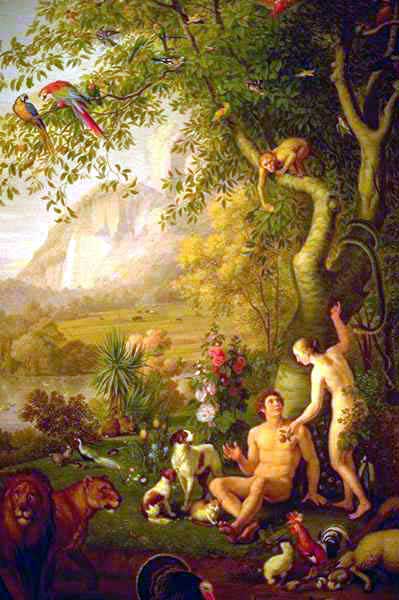
To put it simply, I believe in Evolution as part of the Creation. I also believe in The Garden of Eden, complete with real persons named Adam and Eve. This presents a serious conundrum. Part of our problem is that we are trying to put a round block into a square peg. The two things of The Garden of Eden and Biological Evolution just don't seem to go together. When we try reconciliation, it only ends up messing with one or the other. The importance or existence of one of the two becomes seriously questioned. Assuming that both are correct, how can they be made to co-exist? For years I have been doing a little theological speculation thought experiment on the subject. From my research I have come to a tentative conclusion that they can relate.


First, we must realize that scientific understanding of Creation is not too different from the Scriptural explanations of how it all started. The first day was about the creation of the elemental forces of the universe, particularly light (Gen 1:1-5). The second day talks about the Earth's planetary formation. The land and water are separated from each other, with water probably becoming liquefied below and gaseous above (Gen 1:6-8). After this, the Scriptural account becomes more scrambled from what we know scientifically. Most of the out of order information has to do with the development of time (Abraham 4:13-17). It is more of a conceptual than a creative development, finding uses for what has already been formed.

It is at this point that a very sketchy presentation of Evolution can be read in the material. The first mention of living things is plants, rather than animals (Abraham 4:11-12). This seems consistent with what is known of Earth's development. Plants were the first living things to develop on land. Animals followed later. Reading about the development of animal life can be interpreted to support the idea that life originated in the oceans, as Evolutionary theory postulates:

And the Gods prepared the waters that they might bring forth great whales, and every living creature that moveth, which the waters were to bring forth abundantly after their kind; and every winged fowl after their kind. And the God's saw they would be obeyed, and that their plan was good. (Abraham 4:21)


The Scriptures then state that every creature will bring forth after their kind. For those who don't believe in Evolution, they see this as an indication that changes can't happen. A lion can't bring forth a bear. It wouldn't be after their kind. However, the theory of Evolution doesn't say that is possible either. Any developments would be dependent on the sharing of DNA between two parents. Drastic mutations would hurt the chances for survival. Besides, fossil discoveries seem to provide strong evidence that life has never been static. To me it is about reading two different versions of the same event. God simply didn't fill in the details.

At this point the Garden of Eden must be introduced. Reading of Adam and Eve seems to be a refutation of all that went before. I don't believe that is completely true. Perhaps they have little to do with each other. They both happened, but not for the same reasons. Evolution was in one corner developing life and The Garden in another changing human nature.

The Garden of Eden was most likely the first Temple on the Earth (see The Gate of Heaven by Matthew B. Brown, pg. 26 - 33), and by nature separate from the rest of the planet. Some similarities to the Temple are the Presence of God, a central location, a place where sacred rivers run (see Rev. 22:1), having precious materials that High Priests wear, and etc. It is clear from reading the Scriptural account that the Garden of Eden was a specific place. Modern Revelation has located the Garden of Eden having been in Jackson County Missouri. Like the City of Enoch, it no longer exists on the Earth and might have been taken up to Heaven.

Eventually, although it would have to near the end of Evolution, Adam and Eve were kicked out of the Garden of Eden. It was at this time when the Lord God made coats of skin and clothed them (Moses 4: 27), sending them back to "till the ground from whence he was taken"(Moses 4:29). Adam and Eve had once again become part of the world we know. Pres. Brigham Young said that Adam was born like any person. Perhaps Adam and Eve were taken from the Evolutionary process, made a Son and Daughter of God through Temple ordinances, and returned back when they had become spiritually prepared for a life of choice.

Saturday, March 11, 2006

Discovering the Sacred in the Temple

Years ago I first entered the Temple as an emerging adult about to enter the mission field. Although many memories of that experience are vague, there were some thoughts and feelings that are not forgotten. Like many who enter for the first time, it is never what was imagined even after careful (and proper) research. It was strange to see and participate in such a richly symbolic activity. I think, however, that first shock is for a purpose known as initiation. Many cultures have unique and demanding rituals that bridge the gap between the child and adult world. Two reactions are possible. The first is fear of the unknown and never going back. The other, and the one that brought me back, was a need to understand. Years later, I would like to leave some suggestions how to get more out of Temple attendance.

Do not be afraid to return. This should go for all those who might attend for the first time, or have not gone back. Spiritual rewards will outstrip any discomfort from the unusual experience. There are some things in life that must be carefully cultivated in order to enjoy. Learning from the Temple takes time, patience, and prayerful contemplation. Searching the Scriptures is essential to coming to understand the symbolism and meaning behind the experience.

Become familiar with Covenants. We take upon ourselves the name of Jesus Christ at the time of Baptism. This includes a covenant to obey the Commandments of God:

15 Yea, I say unto you come and fear not, and lay aside every sin, which easily doth beset you, which doth bind you down to destruction, yea, come and go forth, and show unto your God that ye are willing to repent of your sins and enter into a covenant with him to keep his commandments, and witness it unto him this day by going into the waters of baptism.

16 And whosoever doeth this, and keepeth the commandments of God from thenceforth, the same will remember that I say unto him, yea, he will remember that I have said unto him, he shall have eternal life, according to the testimony of the Holy Spirit, which testifieth in me.

- Alma 7:15-16


The Temple contains similar covenants we have made at the time of our Baptism. They are split into three different areas. The first is covenants we make as individuals. the second set of covenants we make in regards to family responsibilities. The last set of covenants has to do with our membership in the community of Saints. Become familiar with the Ten Commandments and that we should love God and neighbor. Finally, we should do more than recite covenants, but live them with faith. The more covenants we keep, the more blessings we reap.

Recognize the meanings of symbols. Surprisingly, most of the symbolic meanings found in the Temple experience are spelled out in either words or relationships. Watch carefully what happens and listen for any narrative explanations. The key to undestanding a great deal of the Temple is knowing we are the central focus. It is a representative journey from pre-mortal existance to our return to Heavenly Father through the Atonement of Jesus Christ. This is where a good understanding of Scripture is most helpful, noticing the various allusions to scriptural teachings introduced in new and personal ways.

Use the less understood parts to your advantage. Memory is a vital purpose of the Temple experience. It seeks to bring to mind our place in the Universe and Plan of Salvation. If you do not understand something, try to at least remember it during the rest of the time. It could end up relating to another thing you do undestand, bringing meaning to both. Even if you still don't understand it, focus on what you do know and remember what you don't for later. Part of the joy of continually going to the Temple is that we learn something new each participation.

These are, from my experience over the years, important steps to gaining a sacred respect for the Temple. It takes more than a passive response to become spiritually invigorated by the rich texture that is the Temple.

Let us truly be a temple-attending and a temple-loving people. We should hasten to the temple as frequently, yet prudently, as our personal circumstances allow. We should go not only for our kindred dead but also for the personal blessing of temple worship, for the sanctity and safety that are within those hallowed and consecrated walls. As we attend the temple, we learn more richly and deeply the purpose of life and the significance of the atoning sacrifice of the Lord Jesus Christ. Let us make the temple, with temple worship and temple covenants and temple marriage, our ultimate earthly goal and the supreme mortal experience . . .

. . . All of our efforts in proclaiming the gospel, perfecting the Saints, and redeeming the dead lead to the holy temple. This is because the temple ordinances are absolutely crucial; we cannot return to God’s presence without them. I encourage everyone to worthily attend the temple or to work toward the day when you can enter that holy house to receive your ordinances and covenants. As the prophets have said, the temple is a place of beauty; it is a place of revelation; it is a place of peace. It is the house of the Lord. It is holy unto the Lord. It must be holy and important to us.

- Howard W. Hunter, “A Temple-Motivated People,” Ensign, Feb. 1995, 2

Saturday, February 18, 2006

What's in a Name? Lamanite Redux

All this talk of Lamanites and DNA is not only old, it is really meaningless. Because of a major news "story" in the LA Times, a completely irrelavant discussion has been resurrected. The more informed treatments can be found here, and this place, and finally here with plenty of counter arguments. Personally, I don't think DNA and what it tells us about the Book of Mormon is the correct question. What is really at issue is what does "Lamanite" and "Nephite" mean? How much of the identification is familial and how much is rhetorical? It might be a little of both and far from mainly one.

The Book of Mormon started out classifying the Lamanites as Lehi's decendants; mostly the brothers of Nephi. That is true enough. Something, however, happened that quickly made that identification muddled. Almost from the start the Lamanites consisted of at least two groups of unrelated peoples. There was Laman and Lemual and then sons of Ishmael. The Nephites had Sam and daughters (perhaps with some sons) of Ishmael. Soon, other groups start popping up everywhere. Some don't even seem to have a cursory relationship to Lehi. In fact, and this is what most Mormons miss and Hugh Nibley constantly pointed out, the primary ancestors of the Book of Mormon peoples were Jaredites! Nephites and Lamanites are meeting the Jaredites everywhere according to name patterns. I think the Mulekites might have been Nephites who ran into a large population of Jaredites and incorporated themselves into the political structure. Both the Mulekite Nephites and Jaredites lost their original cultural connections. The point is, there were other groups living and mingling with each other.

Along with the above diversified populations, there was an event that totally and completely destroyed the very concept of Lamanite and Nephite as family relationships. It was the coming of Jesus Christ. During his ministry both the Lamanites and Nephites, and all other peoples, became one community. It lasted at least a hundred years. After this short era of unity, Lamanite and Nephite became a religio-social designation.

4 Ne. 1: 20
20 And he kept it eighty and four years, and there was still peace in the land, save it were a small part of the people who had revolted from the church and taken upon them the name of Lamanites; therefore there began to be Lamanites again in the land.


It was a self-identy more than family lineage; although some sense of relationships might have inspired the usage. Even then, the designations became fragmented into other sub-groups. One of the most major writers/editors of the Book of Mormon seemed aware that his literally a Nephite was important enough to mention. There were plenty of other groups who weren't.

Mormon 1: 5-10
5 And I, Mormon, being a descendant of Nephi, (and my father’s name was Mormon) I remembered the things which Ammaron commanded me.

6 And it came to pass that I, being eleven years old, was carried by my father into the land southward, even to the land of Zarahemla.

7 The whole face of the land had become covered with buildings, and the people were as numerous almost, as it were the sand of the sea.

8 And it came to pass in this year there began to be a war between the Nephites, who consisted of the Nephites and the Jacobites and the Josephites and the Zoramites; and this war was between the Nephites, and the Lamanites and the Lemuelites and the Ishmaelites.

9 Now the Lamanites and the Lemuelites and the Ishmaelites were called Lamanites, and the two parties were Nephites and Lamanites.

10 And it came to pass that the war began to be among them in the borders of Zarahemla, by the waters of Sidon.


Criticism has been made that early and many modern LDS Church authorities have said that all Native Americans are Lamanites. It is claimed this make it official doctrine. The one place that should set the tone for official doctrine, the Doctrine and Covenants, is not as clear on the subject as first supposed. The Doctrine and Covenants follows the Book of Mormon in catagorizing and then qualifying the names.

D&C 3: 16-20
16 Nevertheless, my work shall go forth, for inasmuch as the knowledge of a Savior has come unto the world, through the testimony of the Jews, even so shall the knowledge of a Savior come unto my people—

17 And to the Nephites, and the Jacobites, and the Josephites, and the Zoramites, through the testimony of their fathers—

18 And this testimony shall come to the knowledge of the Lamanites, and the Lemuelites, and the Ishmaelites, who dwindled in unbelief because of the iniquity of their fathers, whom the Lord has suffered to destroy their brethren the Nephites, because of their iniquities and their abominations.

19 And for this very purpose are these plates preserved, which contain these records—that the promises of the Lord might be fulfilled, which he made to his people;

20 And that the Lamanites might come to the knowledge of their fathers, and that they might know the promises of the Lord, and that they may believe the gospel and rely upon the merits of Jesus Christ, and be glorified through faith in his name, and that through their repentance they might be saved. Amen.


Even in the Doctrine and Covenants there is a hint of a political, as much as lineal, meaning behind the names when it comes to teaching the gospel. A rejection of the gospel seems to be one of the ways to gain the designation "Lamanite" beyond who were your ancestors.

D&C 10:48
48 Yea, and this was their faith—that my gospel, which I gave unto them that they might preach in their days, might come unto their brethren the Lamanites, and also all that had become Lamanites because of their dissensions.


It would be nice to know what percent is "brotheren" and "dissenters" in the makeup. As it is, that could be anyone's guess. There is no doubt that the names Nephite and Lamanite still hold very specific family meaning. When you speak of Lamanite, it can very well be understood as having a relation to Lehi. However, the relationship is thin. It is more like saying Latter-day Saints are of the House of Israel. True enough from a spiritual standpoint. If we are to believe the Scriptures that is true from actual fact; as long as we understand the dilution of the original Israelite blood in our Gentile genes. So, from that perspective the Lamanites are the main progenators of Native Americans. Problem is, that isn't saying much. The original gene pool was mixed up, changed, scattered, and redefined long before Columbus. The answer to the DNA question is in the Book of Mormon. It just takes some paying attention.

Friday, January 13, 2006

Yet Again: Yes Mormons are Christians

The idea that they are not is inconceivable. It bears repeating that "Mormon" is only a nickname for The Church of Jesus Christ of Latter-day Saints. Going back to the original designation doesn't refute the Christian label either. It started out as "The Church of Christ" and progressed to the lengthy name we have today. There are, of course, some reasonable assumptions why "Mormons" cannot be called Traditional or Orthodox Christians, but they are not strong enough for an all-out descrimination.

The Trinity

This is usually seen as the number one reason for excluding "Mormons" from the lexicon. The problem is twofold. First, the Trinitarian concept was a rather late theological concept. Before, that were any number of non-Trinitarian concepts of Jesus and his relationship to God. Admittedly, the most talked about are the ones that rejected Jesus' divinity. That is something that even Mormons would consider false and suspect for inclusion in the Christian demographic. But, there were still others that believed in divine subordination of Jesus to God rather than fusing them together. The only reason for the exclusion today is because of tradition built from an iron fisted council in the Third Century after Jesus and his Apostles were long dead. As the book Lost Christianities by Bart D. Ehrman suggests, there were many Christian viewpoints of considerable scope and variety. Any number of them could have defined what we now know as Christianity. It is only through a quirk of history, theological wars, and suppression has a seemingly unified Christianity developed.

The second problem is that the Trinity is not particularly Biblical, no matter how much some have continued to argue otherwise. This is not to say there are not Scriptures that bolster the general idea. However, there are plenty of equally commanding Scriptures that can show another possible belief about Jesus' relationship to God. It is beyond the scope of this article to get into that. Plenty of other people, Mormon and non-Mormon (such as Nicene Creed and Truth about the Trinity. ), have discussed the topic. The point is that the Bible doesn't exactly show who is or isn't a Christian beyond the broadest of meanings.

The Book of Mormon and other Scriptures

The idea that a belief in other Scriptures is a prelude to non-Christian identity is problematic in the same way as Trinitary beliefs. Before the Constantine takeover, there were many Christians with many different Scriptures. Once again, "Lost Christianities" shows how delicate a balance the Bible in its present form is to what might have been. Even today there are still argumens over what books should or shouldn't be in the Bible by Orthodox Christians. This is especially the case if considering Catholics vs. Protestants with the so-called apocrypha.

Besides, the Book of Mormon has even been characterized as uber-Christian by the very critics who argue against the Christian self-identification. I will not go so far as to say the recent label of "Another Testament of Jesus Christ" says anything for its Christianity. However, its original introduction still contains the phrase "to the convincing of the Jew and the Gentile that Jesus is the Christ, the Eternal God, manefesting Himself to all nations." The Doctrine and Covenants is no less devoid of Christian statements such as from section 20:

21 Wherefore, the Almighty God gave his Only Begotten Son, as it is written in those scriptures which have been given of him.

22 He suffered temptations but gave no heed unto them.

23 He was crucified, died, and rose again the third day;

24 And aascended into heaven, to sit down on the right hand of the Father, to reign with almighty power according to the will of the Father;

25 That as many as would believe and be baptized in his holy name, and endure in faith to the end, should be saved—

26 Not only those who believed after he came in the meridian of time, in the flesh, but all those from the beginning, even as many as were before he came, who believed in the words of the holy prophets, who spake as they were inspired by the gift of the Holy Ghost, who truly testified of him in all things, should have eternal life,

27 As well as those who should come after, who should believe in the gifts and callings of God by the Holy Ghost, which beareth record of the Father and of the Son;

28 Which Father, Son, and Holy Ghost are one God, infinite and eternal, without end. Amen.

29 And we know that all men must repent and believe on the name of Jesus Christ, and worship the Father in his name, and endure in faith on his name to the end, or they cannot be saved in the kingdom of God.

30 And we know that justification through the grace of our Lord and Savior Jesus Christ is just and true;

31 And we know also, that sanctification through the grace of our Lord and Savior Jesus Christ is just and true, to all those who love and serve God with all their mights, minds, and strength.


32 But there is a possibility that man may fall from grace and depart from the living God;

33 Therefore let the church take heed and pray always, lest they fall into temptation;

34 Yea, and even let those who are sanctified take heed also.

35 And we know that these things are true and according to the revelations of John, neither adding to, nor diminishing from the prophecy of his book, the holy scriptures, or the revelations of God which shall come hereafter by the gift and power of the Holy Ghost, the voice of God, or the ministering of angels.

36 And the Lord God has spoken it; and honor, power and glory be rendered to his holy name, both now and ever. Amen.


Baptism

It is true that Mormons reject other Christian's baptism. That they would decide to reject Mormon baptisms as legit shouldn't be bothersome. However, this is understandable only if one is arguing from an authoritative, rather than theological, standpoint. The idea of not accepting other baptisms isn't because of what one believes, but by what authority one holds. Mormons simply believe they have been given the authority to act in the name of God and that other Christian denominations do not.

It is not much different than what most Protestants think of Catholics. Then again, there are many Protestants who don't think Catholics are Christians; an even more dubious exclusion. Interesting enough, there are some Christians who don't believe in baptisms at all, even if they accept the idea of such a practice. Never in 1000 years would Mormons not consider others as Christians simply because of a matters of authority. After all, the Christian religion is still splintered over that very topic or there wouldn't be so many different denominations (that isn't the only reason, but it basically boils down to who has the authority to interpret doctrine and practice).

Concluding Thoughts

There is much more that could be said on the subject. The book Are Mormons Christians by Stephen E. Robinson is more detailed and focused on the issue. To refuse the title "Christian" to Mormons, or think it a recent ruse, is to be either ignorant of what Mormons believe or extremist sectarian. It is true that we have different ideas about Jesus Christ than most mainstreamers officially accept, but ther are plenty of Christians ( Marcus Borg comes to mind) who could be defined as less Christian than Mormons are, yet still undisputedly hold that title. A belief in a divine Jesus Christ is more than just theology for Mormons. He defines our very lives as much as any mainline Christian. To deny that Mormons are Chrisitans is to do more than argue theology. It is an insult, and those who refuse to acknowedge the Mormon self-identification know it!

Note: see Understanding the Godhead for a discussion of what Mormons believe about the relationship of Father, Son, and Holy Ghost.